Wednesday, April 8, 2020

Tuesday, October 24, 2017
Ten Little Caterpillars by Bill Martin Jr.
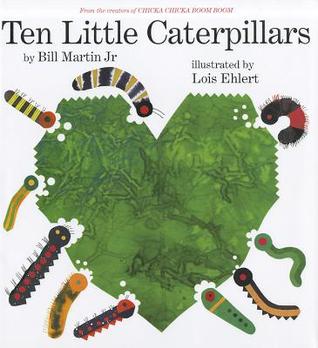
Title: Ten Little Caterpillars
Author/Illustrator: Bill Martin Jr.
Reviewed By: Teresa Urena
Recommended Grade Level: Preschool - First Grade
Pre- Kindergarten Common Core Standard:
Reviewed By: Teresa Urena
Recommended Grade Level: Preschool - First Grade
Pre- Kindergarten Common Core Standard:
Counting and Cardinality
Know number names and the count sequence
1. Count to 20
Compare Numbers
Compare Numbers
Count to tell the number of objects.
3.
Understand the relationship between numbers and quantities to 10; count to cardinality.
a. When counting objects, say the number names in the standards order, pairing each object with one only one number name and each number name with one and only one object.
b. Understand that the last number name said tells the number name said tells the number of objects counted. The number of object counted. The number of objects is the same regardless of their arrangement or the order in which they were counted.
c. Understand that each successive number name refers to a quantity that is one larger.
Summary:
This book tell the story about ten little caterpillars and how they transformed into ten beautiful different butterflies. Each page of the book is make in wonderful watercolor collage against a white background.The illustration have texture and vibrant color that create the perfect habitat where you can find ants, spiders, frog, birds and beetles. Each items in the picture is labeled to build vocabulary and sight word recognition. Children can count and compare each caterpillar, and they can incorporate subtract concepts into the story.
Rating:

I gave this book at rating of 5 starts because I like the vibrant color in each pages, and children with special needs will be attractive to the beautiful color in the illustration. They can see different types of flower and not only learn math but science can be incorporate into the lesson. Children can count the caterpillar as well as items on the pages like leaves, ladybugs, and flower. They can learn life cycle by looking at the transformation of the caterpillar into butterflies.
Classroom Ideas:
This book offers wonderful ideas for teacher to explore and expand their student’s knowledge.
a. The teacher can create their caterpillar and use to count and compare with the one in the book.
b. The teacher can compare similarity and difference between their different caterpillars.
c. The teacher will gave each child a caterpillar to keep as a story token to bring home.
Used the created caterpillars as inspiration
Sunday, October 22, 2017
Ten Apples Up on Top
Title:
Ten Apples Up On Top!
 Author and Illustrator: Dr.
Suess and Roy McKie
Author and Illustrator: Dr.
Suess and Roy McKie
Written as: Theo.
LeSieg
Recommended reading level: Pre-K-2
PKSS.MATH.CONTENT.PK.CC.3.A
When counting objects, say the number names in the standard order, pairing each object with one and only one number name and each number name with one and only one object.
PKSS.MATH.CONTENT.PK.CC.3.B
Understand that the last number name said tells the number of objects counted. The number of objects is the same regardless of their arrangement or the order in which they were counted.
PKSS.MATH.CONTENT.PK.CC.3.C
Understand that each successive number name refers to a quantity that is one larger.
PK.SS.MATH.CONTENT.PK.CC.4
Count to answer “how many?” questions about as many as 10 things arranged in a line, a rectangular array, or a circle, or asmany as 5 things in a scattered configuration; given a number from 1–10, count out that many objects.
SUMMARY:
Follow along as Lion, Tiger and Dog compete to see who can carry the most apples on their heads! Watch out though -- Bear doesn't seem too happy with their game! Will the three pals be able to get ten apples up on top?
RATING:
I give this book a 5 star rating! It's funny, well-illustrated and engages children in counting and prediction. Children can get up and count along with Lion, Tiger, and Dog.
TEACHER IDEAS:
This book is great for working on counting and cardinality, one-to-one correspondence, and working on the concept of "one more" and "one less." Children can use bean bags as "apples" and see how many they can hold on their head; they can use pictures of themselves and glue apples on top; they can practice pointing and rote counts. Materials like counters, or even actual apples, can be used to help reinforce these ideas.
Tuesday, October 10, 2017
"One" by Kathryn Otoshi

Title: One
Author/Illustrator: Kathryn Otoshi
Reviewed By: Belinda Roman
Recommended Grade Level: Preschool - First Grade
Pre- Kindergarten Common Core Standard:
Counting and Cardinality
Know number names and the count sequence
1. Count to 20
Compare Numbers
5. identify whether the number of objects in one group is more, less, greater than, fewer, and/or equal to the number objects in another group ,e.g., by using matching and counting strategies.
Summary: This book tells the story of Blue the quiet color and how he is picked on by Red the hot head. The other colors see and do not like it but are too afraid to do anything. Then the number 1 comes along and stands up to Red. He helps the other colors stand up for themselves too and count. Even Red has a change of heart and learns he can count to without being a bully.
Rating:
Reviewed By: Belinda Roman
Recommended Grade Level: Preschool - First Grade
Pre- Kindergarten Common Core Standard:
Counting and Cardinality
Know number names and the count sequence
1. Count to 20
Compare Numbers
5. identify whether the number of objects in one group is more, less, greater than, fewer, and/or equal to the number objects in another group ,e.g., by using matching and counting strategies.
Summary: This book tells the story of Blue the quiet color and how he is picked on by Red the hot head. The other colors see and do not like it but are too afraid to do anything. Then the number 1 comes along and stands up to Red. He helps the other colors stand up for themselves too and count. Even Red has a change of heart and learns he can count to without being a bully.
Rating:

Classroom Activity:
1. Number Color collage
Provide students with pre-cut numbers and have them glue on colored tissue paper to the corresponding character from the story. Then have each student share why they chose that character and then have the whole group count the collages in order, then display on classroom bulletin board.
Ten Black Dots
Ten Black Dots

Title:
Ten
Black Dots
Author
and Illustrator: Donald
Crews
Recommended
Grade Level: Preschool-Kindergarten
Common
Core Standards Addressed:
PK. CC
Count
to tell the number of objects.
3. Understand
the relationship between numbers and quantities to 10; connect counting to
cardinality.
a. When
counting objects, say the number names in the standard order, pairing each
object with one and only one number name and each number name with one and only
one object.
b. Understand
that the last number name said tells the number of objects counted. The number
of objects is the same regardless of their arrangement or the order in which
they were counted.
c. Understand
that each successive number name refers to a quantity that is one larger.
4. Count to answer “how
many?” questions about as many as 10 things arranged in a line, a rectangular
array, or a circle, or as many as 5 things in a scattered configuration; given
a number from 1–10, count out that many objects.
Common Core Standards for Mathematical Practice:
Model with mathematics
*Students should be able to
learn from this book that countable objects are present all over our real-life environments.
Students should use the counting skills learned in this book, to solve problems
involving counting objects in their environments (ex. being able to take out a
specific number of toys from the toy box).
CCSS.MATH.PRACTICE.MP6
Attend to precision.
*Students should learn from
this book that each number name corresponds with a specific number symbol.
Students should also learn from this book that each number represents a
specific quantity of items.
Summary:
This book’s goal is to
teach students how to count from 1-10. This book explains how dots are found in
common things in our environment. The book gives examples of things that
contain 1-10 dots in order. At the end of the book, the author encourages the
reader to count lines of dots of 10 and under, to reinforce the counting skills
taught in the book.
Rating:
I think this is a four-star
book for teaching students counting skills. I really like that the book shows
students how counting can be incorporated in the real world and how most things
we encounter on a daily basis can be counted. The only thing that concerns me
is that this book only focuses on counting dots. From this book, students may
misunderstand and think that dots are the only things we can count. After
reading the book to the students, the teacher should clarify to students that
we can count dots but that we can count other things as well.
Classroom Ideas
1. You can use this book as
a part of your instruction in teaching students how to count from one to ten.
You can read this book to students during whole class instruction. After
reading the book to the students, you can have some students come up
individually and count a line of dots in the book. You can differentiate instruction
and have students count shorter or longer lines of dots depending on their
counting level. Students who are able to count to higher single digit numbers,
like 8, can could practice counting 9 dots. Whereas, students who are having
trouble counting up to 5, can come up and practice that skill. You can ask
students questions, while they are in front of the class like, if I had one
more dot here how many dots would I have? You can also ask if I started
counting with this dot how many dots would I have? If the student cannot
answer, you can have a friend answer for him or you can explain the answer to
the class.
2. After reading this book
to students, have students work in pairs on a matching game at their tables.
Pair students with lower level counting skills with students who have higher
level counting skills so the student with lower level counting skills can learn
from the student with higher level counting skills. Have students randomly pick
a card with a certain number from 1-10 and then ask them to find a card with that
specific number of objects, or vice a versa. Give students five minutes to play
this game so they do not get bored. Tell the class to keep track of how many
matches they make to also practice counting. Tell the class that whoever gets
the most matches will get a sticker to keep students motivated. Go around the
class to make sure students are on task and to mentally challenge students. For
example, ask a student who matched the symbol to “2” to a card with two balls,
how many balls there be if we had one more ball. Also ask the students how many
of the items they would have if you started counting with a different item.
Have students who successfully answer these questions explain their reasoning
to the whole class after this activity is done so all of the students can learn
even if they originally have difficulty answering these questions. This
activity would reinforce students learning of associating a number symbol, to a
number name and to a number quantity.
3. After reading this book
to students, present students with a problem. My friend Tessa went to the store
and bought a shirt with five black dots, can you draw me a picture of a shirt
with five black dots. If students are easily able to do this ask them to draw a
shirt with eight black dots. If students, are having trouble doing this ask
them to draw a shirt with two black dots. Go around the classroom and make sure
the students understand the task, can articulate how they decided to put a
certain number of dots on their picture and can count the number of dots in
their picture.
4. After reading this book
to students, you can give the students a homework assignment to find an object
in their environment with a certain number of dots. The students can bring the
object to school to show the class and count the dots when presenting their
object to the class. You can differentiate instruction by having students find
an object with a certain number of dots that matches their counting level. For
students, who are having trouble counting to five have them find an object with
five dots. For students, who have mastered counting to five give them an object
to find with seven dots. Inform parents of this assignment through a take home
letter, so they can help their child find objects with a specific number of
dots if needed. This assignment would show students how counting can be used in
real life and that most things in our environment can be counted. Hopefully,
this assignment will serve as an encouragement for students to count more
things in their environment outside of school.
5. After reading the students
this book, give the students a worksheet with shapes that can be created
through connecting the dots. After the students connect the dots to create the
shape, have the students fill in their shape with a crayon. Afterwards, ask the
students to count the number of dots used to create the shape. Also, ask
students what shape they created. Give the students 1 more dot to count than
the number they have mastered counting up to, so a student who mastered
counting to 4 should be given a shape to create using five dots. This activity
also reinforces shape learning.
Five Little Monkeys
Reviewed By: Jaleesa L. Pimentel
Author & Illustrator: Eileen
Christelow

Recommended Grade Level:
- · PreK- Kindergarden
Common
Core Standards for Mathematical Practice:
- · CCSS Math Practice MP 4 Model with mathematics.
- · CCSS Math Practice MP 7 Look for and make use of structure.
Common
Core Content Standards
- · PK.CC.A.2- Represent a number of objects with a written numeral 0-5 (with 0 representing a count of no objects).
- · PK.CC.A.5- Identify whether the number of objects in one group is more, less, greater than, fewer, and/or equal to the number of objects in another group, e.g., by using matching and counting strategies.1 (1: up to 5 objects)
- · PK.OA.1- 1. Demonstrate an understanding of addition and subtraction by using objects, fingers, and responding to practical situations (e.g., If we have 3 apples and add two more, how many apples do we have all together?).
Summary:
- · Five Little Monkeys is an enjoyable, entertaining story about the bedtime routines of five monkeys and their mother. The monkeys carefully complete bedtime tasks such as, taking a bath, brushing their teeth, and putting on their pajamas. The reader may be led to believe that the “respectful” monkeys are ready to go to sleep, but these sneaky five little monkeys have plans. As their mother closes their bedroom door, the monkeys start jumping on their beds! Unfortunately, one monkey falls down and bumps his head. Mama is has to call the doctor, who tells the monkeys, “No more monkeys jumping on the bed.” The remaining monkeys do not listen to the doctor’s order. All of a sudden, all five monkeys are hurt, and they finally decide to go to bed. Now mama can finally go to sleep herself, or perhaps have some fun of her own.
Rating:


I give this book five smiley faces. Adults and children alike
will look forward to reading this book over and over again. The illustrations skillfully
bring the story to life. The expressions on the monkeys’ faces when one falls
off the bed will make readers laugh out loud as they change from innocent to
silly and mischievous. The one thing this book is missing is a warning: This
book will not encourage children to settle down for bedtime!
Classroom
Ideas:
This book has so many ideas for a math lesson:
· This book can be used to
show numbers 0-5.
· This can be used to show
different ways to make 5, for example, 1 and 4, 2 and 3, 0 and 5.
· This can be used to show
greater and less than between numbers 0-5.
Subscribe to:
Comments (Atom)

-
Chicka Chicka 123 Reviewed By: Zuleyma Del Valle Author: Bill Martin Jr and Michael Sampson Illustrator: Lois Ehlert ...
-
 Title: Ten Apples Up On Top! Author and Illustrator: Dr. Suess and Roy McKie Written as: Theo. LeSieg Recommended readi...
 -
 Ten Black Dots Reviewed by: Mandy Gottlieb Title: Ten Black Dots Author and Illustrator: Donald Crews Recom...
